

If you’re ready to grow your podcast organically, then you’ve heard of Podcast SEO.
What Is Podcast SEO?
SEO stands for Search Engine Optimization. In plain English, it’s the practice of using specific words and phrases (keywords) so that when someone searches for a topic you speak on, your content shows up in the results.
You’ve probably heard of SEO in the context of Google and blogging. But podcast SEO works the same way, just on platforms like Apple Podcasts, Spotify, and increasingly, AI search tools like ChatGPT and Alexa.
Think about it this way: right now, someone is opening Apple Podcasts and typing in their exact problem, their exact question, their exact situation. Podcast SEO is what determines whether your show shows up when they do that or whether a competitor’s does.
Why Podcast SEO Matters More Than Social Media Promotion
Most podcasters launch their show and then immediately run back to Instagram to remind everyone it exists. They post a graphic, share it to their stories, maybe send an email. And then they do it again next week. And the week after that.
That’s exhausting, and it means your podcast is being marketed by you more than it is marketing you.
Podcast SEO flips that completely. Instead of you going out to find listeners, listeners come to find you. They’re already searching. They already want what you talk about. You just position yourself to show up when they look.
And here’s what makes this so powerful for coaches and service providers specifically: a podcast episode optimized with SEO can be found two years from now, five years from now, by someone who has never heard of you. That episode can turn a complete stranger into a loyal listener and eventually a paying client… while you’re at the park, on a date night, living your life. That is a completely different game than social media.
So where do you actually start with podcast SEO?
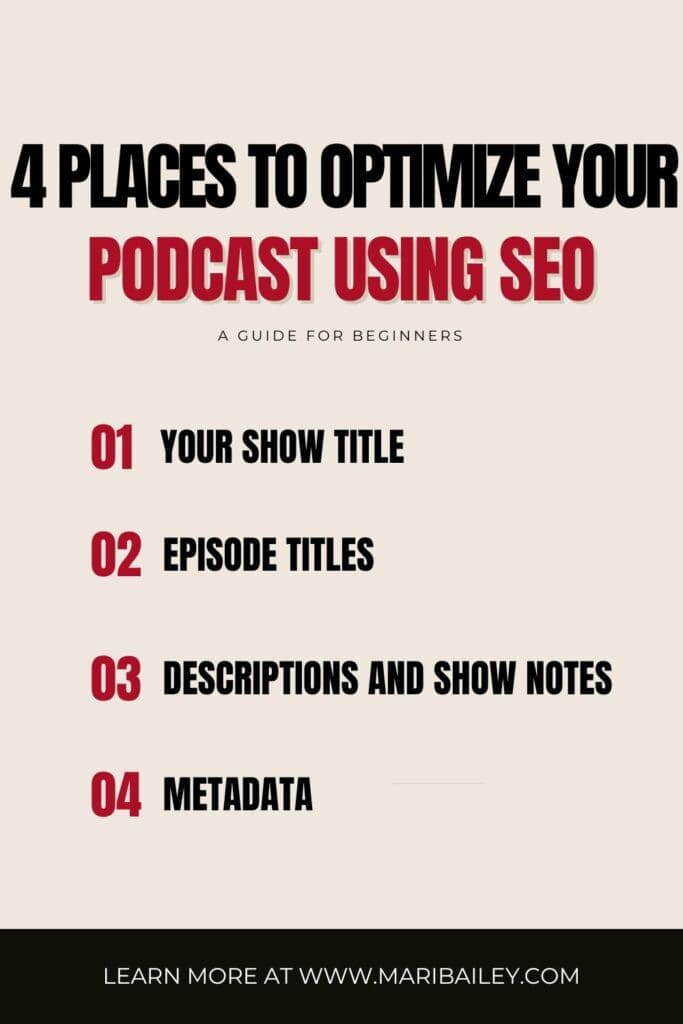
There are four main places. Think of it like placing doors around your storefront. You can have just one door or you can have multiple (one here, one there) so people can walk in from either side. Think of the stores at the mall that have an entrance from the outside and inside! Podcast SEO works the same way. There are specific places where it lives, and when you use all of them together, that’s when your show really builds momentum to begin getting found.
1. Your Show Title
Your podcast show title is one of the strongest SEO signals you send to platforms and listeners. It’s the first thing the algorithm reads and one of the first things a potential listener sees so it shouldn’t be chosen lightly.
If your current title is vague, emotional, or metaphor-driven, it may be costing you discoverability. (If you’re not sure whether your show name is hurting or helping you, go read this post on how to choose the right podcast name.)
And yes, you can change your show title if it’s not working. I’ve done it more than once.
If you’re attached to your name and don’t want to change it, here’s a workaround: add a dash after your title and follow it with keyword phrases. My show is Online Business Made Simple — SEO strategy, podcast growth, content marketing…. Those keywords after the dash are doing a lot of heavy lifting. Go into Apple Podcasts right now and search “SEO strategy.” See where I show up. That’s podcast SEO working exactly as it should.
You don’t need to cram in every keyword you can think of. Five to six relevant phrases is enough. Pick the ones that match what your ideal listener is actually searching for and let those work for you.
2. Your Episode Titles
If I had to pick the single most important place to apply podcast SEO, it would be your episode titles. This is where I see the most missed opportunities and the fastest wins once you fix it.
Here’s the mistake most podcasters make: they title episodes based on what they’re talking about instead of what their listener is searching for. Those are two very different things.
A real example. I had a client with an episode about why she stopped planning her life and what she does instead. Her title was something close to that (Why I Stopped Planning My Life and What I Do Instead). Accurate, sure and also invisible to a cold searcher. Someone scrolling a podcast app has no idea yet why they should care that she stopped planning. There’s nothing in that title that makes them feel seen or gives them a reason to click.
So we reframed it: Tired of Plans Always Falling Through? Here’s Why (And 3 Things to Try Instead). Same episode, same story, same content. But now the title does three things: it meets the listener where they are, names what’s going wrong, and promises a solution. That’s what gets clicked.
When you’re writing episode titles, think about your listener first. What are they feeling? What are they Googling? What problem are they trying to solve? Lead with that and then let the episode deliver.
3. Your Description and Episode Show Notes
Your show description and individual episode notes are valuable podcast SEO real estate that most people either underuse or misuse entirely.
Two things to avoid:
First, don’t drop a wall of hashtags at the bottom of your description. It looks like old Instagram and it doesn’t help your SEO. Instead, weave your keywords naturally into the body of your description as full sentences. If they don’t flow naturally into a sentence, separate them with commas at the bottom (ex: SEO, Podcasting, Podcast).
Second, don’t try to stuff every keyword you’ve ever used into every single episode description. Each episode should have its own keyword focus, maybe one to three phrases that are genuinely relevant to that specific episode. Think of each episode as its own road leading a different person to your show. Someone finds you through an episode about SEO strategy. Someone else finds you through an episode about mindset for entrepreneurs. Once they land, they discover everything else you talk about and they stay.
The more distinct, focused roads you build, the more people you can reach and the more your content compounds over time.
4. Your Metadata
This is the place I see podcasters use the least.
Metadata sounds intimidating but it really isn’t. It’s essentially a caption for your audio file. When you save a podcast episode to your computer, a small box often pops up prompting you to add context directly to the file itself. Most people click “never show this again” because they don’t know what it’s for. That’s a lot of missed opportunity.
Here’s why it matters: that metadata gets read by Google, Apple Podcasts, and AI platforms. So when someone asks Alexa to find a podcast about a specific topic while they’re folding laundry, your episode has a real shot at coming up, but only if you’ve given the file the context it needs to be understood, indexed, and recommended.
It takes two minutes per episode. Fill it in.
Podcast SEO Is a Long Game That Pays Off Forever
Here’s the thing about social media: the moment you stop posting, you stop being seen. The algorithm needs you to keep feeding it. That’s the hamster wheel.
Podcast SEO is the opposite. Every optimized episode you publish is a road that keeps bringing people to you long after you hit publish. You’re not fighting for attention. You’re not trying to out-hook anyone. You’re just showing up in the exact moment someone is already looking for what you offer.
That’s what a sustainable, simple content strategy actually looks like. And it starts with these four places.
If you want to go deeper on the copy side of this — how to write clearly so your content gets found in the first place — go check out this post on clear vs. clever copywriting for business. It pairs really well with everything we just covered.
Want Help Figuring Out the Right Keywords for Your Show?
Come hang out in my free Facebook community, Online Business Made Simple. It’s where coaches and service providers are learning how to get found online, grow their podcast, and build content that markets them without living on social media. Come introduce yourself — I’d love to meet you inside.
👉 Join the free community here
Pin Now. Read Later!
Leave a Reply

HI FRIEND! IT'S MARI
Toddler mama, top 5% global podcast host, and online business strategist with a Master's in IT. I help online businesses get found by clients already looking for them without needing to post daily on social media.

